Jaipur, India · Established 2004
Wool Rugs Manufacturer in India
Planet Arts manufactures handmade wool rugs in Jaipur — hand-knotted, hand-tufted and handwoven constructions, selected to match a buyer's design detail, budget and application, for wholesale, hospitality and custom private-label projects.
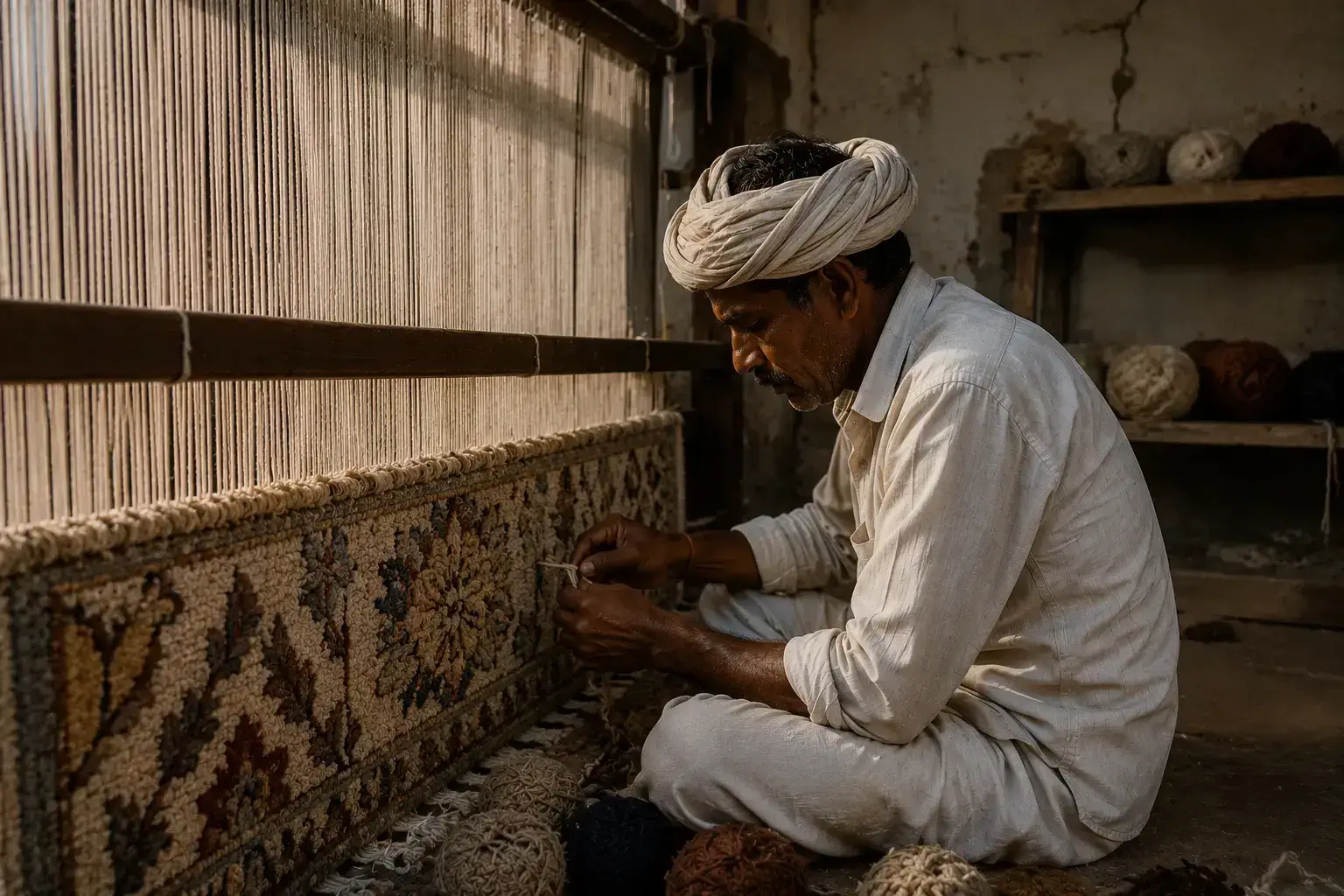
Wool hand-knotting in progress — Jaipur workshop
A Jaipur manufacturer working across three wool constructions
Planet Arts manufactures handmade wool rugs from its Jaipur workshop, established in 2004. Wool is the one material in Planet Arts' range genuinely produced across three distinct construction methods — hand-knotted, hand-tufted and handwoven — which makes construction selection, not material description alone, the central decision for a buyer sourcing wool.
This page is built around that decision: what each construction does with wool specifically, how to choose between them for a given brief, and what a custom wool rug enquiry needs once a construction is selected.
For the full range of materials and constructions Planet Arts manufactures beyond wool, see Planet Arts' rug manufacturing overview.
Construction Selection
Choosing a construction for a wool rug
The same wool yarn produces a materially different rug depending on construction. This is a qualitative comparison to guide specification — not a durability or lifespan claim, which would need testing data Planet Arts doesn't publish.
| Construction | Surface Character in Wool | Design Capability | Typical Application |
|---|---|---|---|
| Hand-Knotted | Dense, defined pile with fine edge control between colors | Highest — gradients, curved motifs, intricate pattern work | Formal interiors, heirloom-grade pieces, statement rooms |
| Hand-Tufted | Medium-to-high pile; sculpted (carved) or level pile finish both achievable in wool | High — bold color blocking, logos, sculpted texture effects wool holds well | Residential and hospitality statement pieces, faster development cycles |
| Handwoven | Flatter, more textural surface; wool's natural loft shows in the weave itself | Medium — geometric and striped patterns suit the weave structure naturally | Layered interiors, transitional spaces, natural-texture-forward rooms |
A practical starting question
Buyers choosing between hand-knotted and hand-tufted wool most often decide on pattern complexity and timeline: hand-knotting suits intricate, fine-detail designs where development time is available; hand-tufting suits bold graphic designs on a shorter development cycle. Handwoven is generally the choice when the brief calls for a flatter, more textural piece rather than a defined pile. See the hand-knotted process or the hand-tufted process for how each is actually made.
Browse the current wool range at wool rugs, the flatweave wool category at flatweave wool rugs, or the premium positioning at luxury handmade wool rugs.
Material Character
What wool does across these constructions
- Pile and density — wool holds pile height and density consistently across knotted and tufted constructions, which is part of why it supports fine design detail.
- Color depth — wool takes dye with more depth and saturation range than jute or cotton in most constructions, supporting more complex colorways.
- Surface resilience — wool fiber has a natural resilience that helps pile recover after compression, relevant to residential and hospitality traffic.
- Design detail — finer wool yarn in hand-knotted work supports curved lines and gradients that coarser fibers like jute can't render at the same resolution.
For a deeper comparison against silk specifically, see Planet Arts' wool vs. silk guide. When a buyer is weighing wool against a coarser natural fiber instead, the jute rug manufacturing page covers that comparison from the other side.
Custom Manufacturing
Custom wool rug manufacturing
Once a construction is selected, custom development covers dimensions, pile height, colorway and pattern detail specific to that construction method.
Concept
Design brief and application discussed, including desired pattern complexity.
Construction Selection
Hand-knotted, hand-tufted or handwoven confirmed against the brief.
Development
Sampling to validate pile, color and pattern before production.
Production
Full production run against the approved sample.
Finishing & QC
Washing, clipping, and inspection.
Dispatch
Packaging and export handling to the destination market.
Information to include in a custom wool rug enquiry
Sharing the following upfront helps scope a custom wool project accurately.
- Dimensions (or room/space measurements)
- Construction preference (hand-knotted, hand-tufted, handwoven) — or ask for guidance if undecided
- Design reference or inspiration image
- Preferred color palette
- Pile height preference, if known
- Order quantity
- Intended application (residential, hospitality, retail)
- Destination country
See Planet Arts' wool rug manufacturing process for the fuller technical walkthrough this page draws on.
Wholesale & Export
Wholesale wool rug sourcing
Planet Arts supplies wool rugs directly to professional buyers across the following categories.
Importers & Wholesalers
Bulk sourcing across all three wool constructions for resale.
Retailers
Standard and private-label wool rug sourcing for retail and e-commerce catalogues.
Interior Designers & Architects
Custom wool development matched to specific residential or commercial design projects.
Hospitality Procurement
Hand-tufted and hand-knotted wool for hotel, resort and commercial interiors.
Planet Arts exports as a CEPC-affiliated business.
Process
Wool manufacturing process
The stages below vary depending on which of the three constructions is selected — knotting, tufting and weaving diverge after yarn preparation.
Design & Construction Confirmation
Pattern, colorway and chosen construction method confirmed before production begins.
Wool Yarn Preparation
Dyeing and preparation of wool yarn ahead of knotting, tufting or weaving.
Knotting / Tufting / Weaving
Construction carried out by hand according to the confirmed method.
Washing
Hand-washing to set the pile and refine surface character, where the construction calls for it.
Clipping & Finishing
Pile trimming and edge finishing specific to the construction.
Inspection, Packaging & Dispatch
Quality inspection followed by packaging for export shipment.
See the full wool rug manufacturing process, or the construction-specific hand-knotted and hand-tufted process pages for more detail on each.
Quality
Quality considerations specific to wool
- Knot/tuft/weave consistency — even density and tension across the rug's surface, appropriate to the chosen construction.
- Pile evenness — consistent pile height across knotted and tufted rugs, with clean sculpting where carved detail is specified.
- Color consistency — even dye uptake and pattern alignment across the rug's surface.
- Dimensional accuracy — finished measurements matching the specified order dimensions after washing and finishing.
- Edge and binding quality — secure, clean edge finishing appropriate to the construction.
- Inspection — visual and dimensional checks carried out before packaging.
For a technical measure of hand-knotted wool density specifically, see Planet Arts' note on knots per square inch (KPSI).
Applications
Wool rugs manufactured for
Formal Residential
Hand-knotted wool for statement and heirloom-grade rooms.
Retail Collections
Wholesale and private-label wool sourcing across all three constructions.
Interior Design Projects
Construction and pattern matched to a designer's specific brief.
Hotels & Hospitality
Hand-tufted and hand-knotted wool suited to hospitality traffic and design programs.
Layered Transitional Spaces
Handwoven wool for a flatter, more textural layer.
Custom Projects
Fully custom construction and pattern development for a specific brief.
Why Planet Arts
Verified basis for shortlisting
- —
Established 2004
Manufacturing continuously from Jaipur since 2004.
- —
Three wool constructions
Hand-knotted, hand-tufted and handwoven, not a single fixed format.
- —
Construction guidance, not just production
Support in selecting the right construction for a given brief, not only executing a pre-decided spec.
- —
B2B and export orientation
Structured for wholesale, hospitality and international buyer workflows, as a CEPC-affiliated exporter.
Trade affiliations & credentials
FAQ
Frequently asked questions
What handmade wool rug constructions are available?
Hand-knotted, hand-tufted and handwoven wool rugs. See Construction Selection above for how they compare.
Can wool rugs be custom designed?
Yes. Dimensions, construction, pile height, colorway and pattern can be developed to a buyer's brief. See Custom Wool Rugs.
What is the difference between hand-knotted and hand-tufted wool rugs?
Hand-knotted rugs are built knot by knot around warp threads, supporting the finest pattern detail but taking longer to produce. Hand-tufted rugs are made by punching yarn through a backing with a tufting gun, which suits bold designs on a shorter development cycle. See the full comparison in Construction Selection.
Can professional buyers source custom wool rugs from Planet Arts?
Yes. Planet Arts works with importers, wholesalers, retailers, interior designers and hospitality buyers on both standard wool collections and custom-developed pieces.
Which wool construction suits hospitality projects?
Hand-tufted and hand-knotted wool are generally specified for hospitality interiors, matched to the traffic level and design programme of the specific space.
Does Planet Arts export wool rugs internationally?
Yes, as a CEPC-affiliated exporter.
More questions are answered on our full FAQ page.