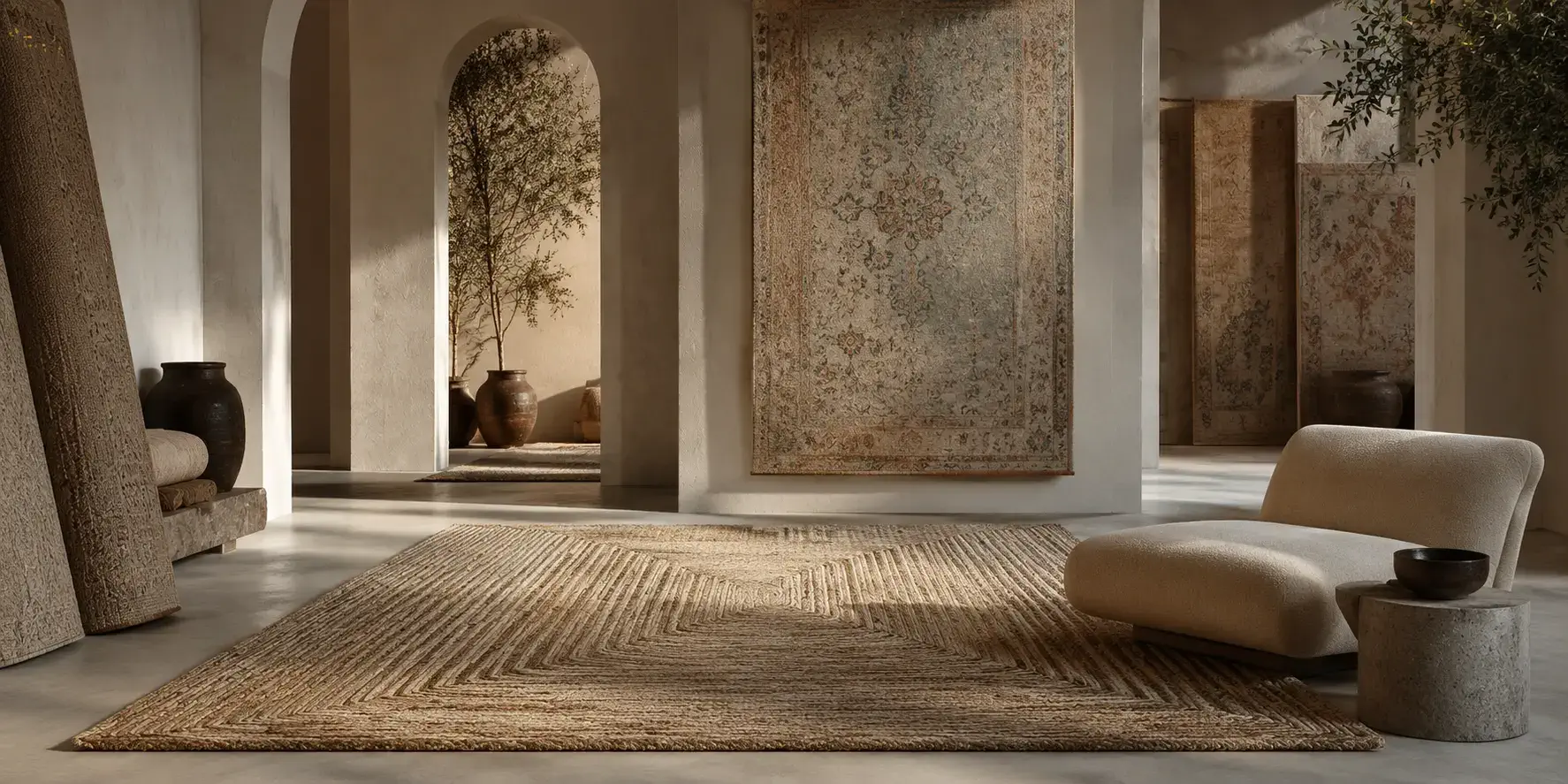
Jute Rugs:
The Art of
Natural Ground
Luxury handwoven jute rugs crafted by master artisans in Jaipur, India. Rooted in centuries of handloom tradition. CEPC-certified. Made with the earth's most renewable fiber.
What Are Jute Rugs?
A jute rug is a floor covering woven from the natural bast fibers extracted from the stem of the jute plant (Corchorus olitorius or Corchorus capsularis). Classified within the natural fiber rug family alongside sisal, seagrass, hemp, and coir, jute rugs are distinguished by their warm golden-brown palette, matte earthy texture, and complete biodegradability at end of life. Jute is uniquely the softest of all major plant-fiber floor coverings, making it the natural fiber rug of choice for bedrooms and living rooms where sisal or coir would be uncomfortably coarse.
Jute fiber is composed primarily of cellulose (65–72%) and lignin (12–14%), with smaller amounts of hemicellulose, pectin, and ash. This molecular architecture explains two of jute's most defining properties: its tensile strength — which allows the weaving of durable rugs capable of supporting years of moderate foot traffic — and its hygroscopic sensitivity, meaning jute absorbs and releases atmospheric moisture readily. This is why jute rugs perform best in dry or climate-controlled environments rather than high-humidity spaces.
The fiber's lignin content imparts its characteristic natural color — the same amber-gold compound responsible for the warm tones of wood and aged paper. This is not a dye but an inherent structural quality, which means natural jute rugs gradually lighten with UV exposure, subtly patinating toward a paler, more silvered gold over years of use. In well-designed interiors, this aging is considered a feature rather than a flaw.
In the luxury interior design market, jute rugs occupy a specific and important position: they provide the warmth, texture, and organic authenticity of a handmade natural material at a price point that allows generous scale — covering large areas that would be cost-prohibitive in wool or silk, while anchoring a room's material palette with undeniable authenticity. They are simultaneously the most accessible and the most compositionally essential natural fiber floor covering available.
A History Written in Golden Fiber
Jute has been cultivated in the Indian subcontinent for over three millennia, with documentation of its use in the Bengal region tracing to at least the 3rd century BCE. The Sanskrit term juta — meaning "matted hair" — captures the fibrous, strand-like quality of the raw material. For most of its pre-industrial history, jute served utilitarian purposes: rope, sacking, coarse cloth, and the packaging of goods moving along ancient trade routes from Bengal to the Arabian Peninsula and East Africa.
The industrialization of jute processing began not in India but in Dundee, Scotland in the 1830s, when mill operators discovered that whale oil could soften jute sufficiently for mechanized spinning on existing flax and wool machinery. Within a decade, Dundee had established itself as the world's primary jute processing center. The first power-driven jute spinning mills in South Asia opened in Kolkata in 1855; by 1900, the lower Ganges delta was exporting over one million metric tons of raw jute annually — earning jute the epithet "the golden fiber" for both its color and its commercial importance to the Bengal economy.
The Partition of 1947 severed the jute-growing regions of East Bengal (Bangladesh) from the milling infrastructure of West Bengal, restructuring global trade permanently. Raw fiber production concentrated in Bangladesh; manufacturing capability evolved across India, particularly in Rajasthan. The cultural and commercial reinvention of jute — from industrial commodity to luxury interior material — occurred gradually through the environmental design movements of the 1970s and accelerated sharply with the organic modern and sustainable interior design movements of the early 2000s. By 2010, jute rugs were firmly established in the specification portfolios of high-end residential and hospitality designers worldwide.
Origins of Jute Rug Weaving
While jute cultivation is geographically concentrated in the Bengal delta and Brahmaputra valley, the transformation of jute fiber into decorative floor coverings developed most powerfully in Rajasthan — a region that brought centuries of established handloom expertise in wool, cotton, and silk textiles. Jaipur emerged as the decisive center of jute rug production, drawing on artisan communities who had mastered flatweave dhurrie construction, pile knotting, and hand-braiding — techniques directly applicable to jute yarn. The Carpet Export Promotion Council of India (CEPC), headquartered in Jaipur, created the institutional framework connecting manufacturers with international buyers, establishing the quality standards and certification infrastructure that gave global importers confidence in Indian handmade floor coverings. Planet Arts has operated within this CEPC ecosystem since its founding in 2004.

How Jute Is Cultivated

| Attribute | Corchorus olitorius (Tossa) | Corchorus capsularis (White) |
|---|---|---|
| Fiber Length | Up to 4 meters | 1.5–2 meters |
| Fineness | Finer, softer | Coarser |
| Color | Warm golden-brown | Off-white to pale gold |
| Primary Use | Premium decorative rugs | Industrial textiles, economy rugs |
| Relative Cost | Higher | Lower |
The jute plant belongs to the genus Corchorus, with two commercially cultivated species: Corchorus olitorius (Tossa jute — finer, longer fibers, preferred for premium rug production) and Corchorus capsularis (White jute — shorter-fibered, more abundant, used for industrial applications and economy-grade textiles). Both require a narrow combination of tropical climate, high humidity, alluvial floodplain soil, and monsoon flooding that makes the Bengal delta region essentially the world's only viable large-scale production zone.
Cultivation follows an annual monsoon cycle. Seeds are sown March through May into prepared alluvial beds, planted densely to encourage tall, straight growth and suppress branching. The plants reach 2–4 meters at maturity, developing pencil-thin stalks that maximize bast fiber yield. Harvest begins in July and continues through September — timed with monsoon rainfall that simultaneously nourishes the crop and enables the subsequent retting process. The crop matures in 120–150 days, yielding 2–3 metric tons of dry fiber per hectare.
From an agricultural sustainability standpoint, jute is exceptional. The crop requires minimal synthetic pesticide because dense planting suppresses weeds naturally and its chemical composition deters most agricultural pests. Fertilizer inputs are modest; the alluvial floodplains where jute grows receive natural nutrient replenishment from annual flooding. After harvest, jute root systems aerate the soil, and the leaf fall — 7–10 metric tons of organic matter per hectare per season — improves soil structure and fertility for subsequent crops. Jute is genuinely regenerative in the strict agricultural sense of that term, not simply marketed as such.
The water required for jute production comes overwhelmingly from monsoon rainfall and natural flooding — not from irrigation. Unlike cotton, which is one of the most water-intensive crops on earth, jute's water footprint is aligned with its rain-fed regional hydrology. This distinction is important when comparing the environmental credentials of jute rugs to cotton alternatives.
How Jute Fibers Are Processed
From harvested stalk to weavable yarn — five precision stages that determine final fiber grade and quality.
Harvested jute bundles are submerged in slow-moving water — rivers, ponds, or retting tanks — for 10–30 days. Microbial enzymatic action breaks down the pectin binding bast fibers to the woody stalk core (hurds). Water quality and movement determine fiber grade: clear, slow-flowing water produces finer, more uniformly colored fiber. Fast retting weakens fiber; under-retting leaves the strands bonded and difficult to separate cleanly.
After retting, workers separate long bast fiber strands from the stalks by pulling downward against the stalk axis — a skilled hand operation. Intact fiber lengths of 1–4 meters are the goal. Damaged or unevenly retted fiber becomes apparent at this stage. Stripped fiber is washed in clean water to remove residual plant material before the next stage.
Washed fibers are hung on bamboo poles or spread flat to sun-dry for 2–3 days. Drying rate affects final color: shade-drying preserves a purer golden tone; rapid sun-drying darkens fiber toward amber. Once dry, fibers are sorted by length, strength, luster, and color into grades. TD-1 and TD-2 (finest grades) are reserved for premium decorative rugs; coarser grades go to industrial applications including burlap, sacking, and rope.
Graded fiber is processed through carding rollers that disentangle and align individual strands. The carded fiber passes through drawing frames that progressively reduce its thickness and improve fiber alignment, producing a continuous sliver — a loose, untwisted rope of parallel fibers — ready for spinning. The quality of carding determines yarn evenness and surface uniformity in the finished rug.
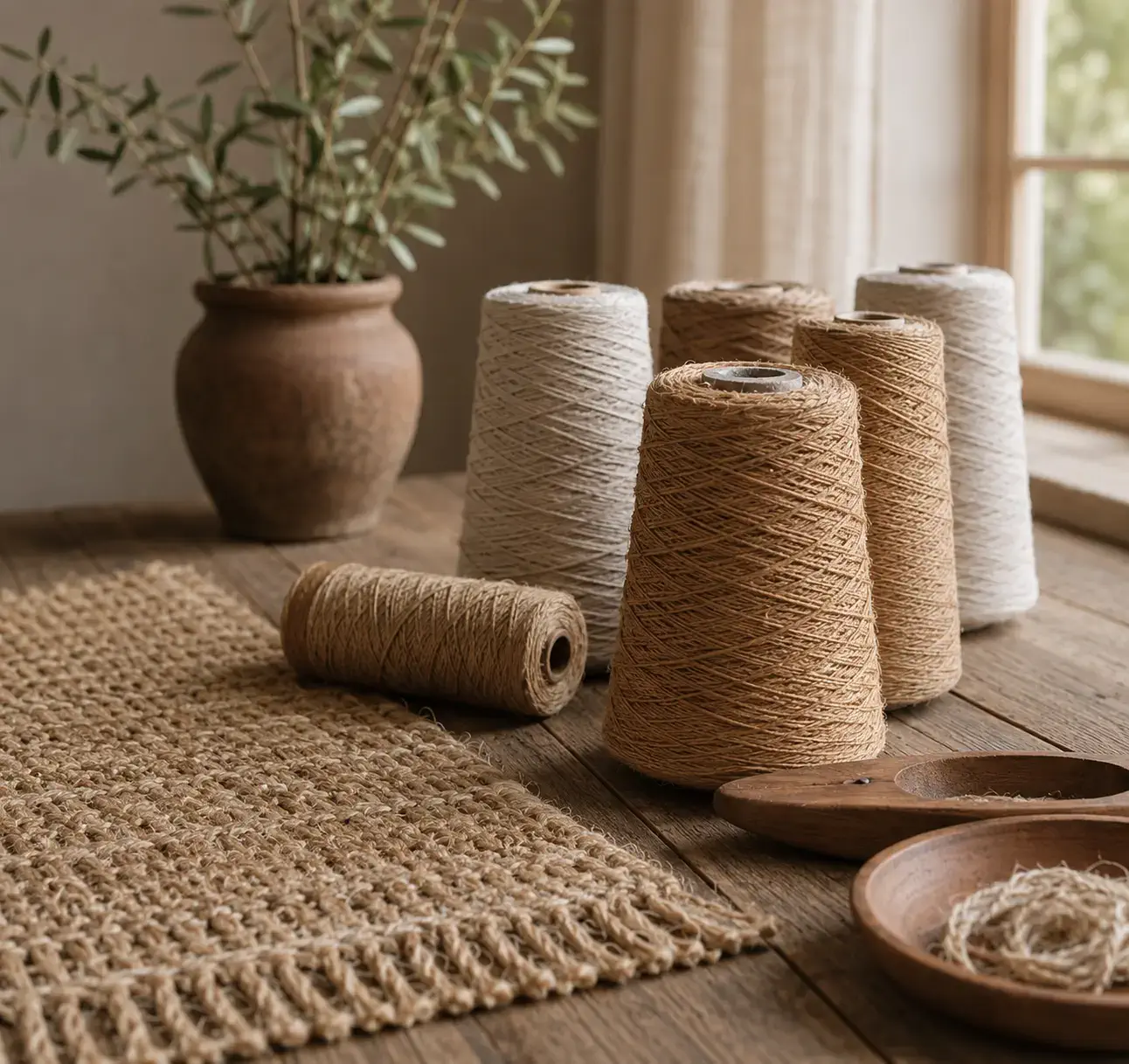
The sliver is twisted into yarn on ring-spinning frames (for consistent, fine, high-tenacity yarns) or semi-mechanical devices for artisanal production with desirable irregularity. Yarn specifications — twist per meter, ply count, diameter — are set here and directly determine the finished rug's texture, weight, and durability. Premium flatweave jute rugs use 2-ply or 3-ply yarn; braided constructions use multi-strand cord twisted to 8–20mm.
How Jute Rugs Are Manufactured
Stage 1: Design & Yarn Specification
Each production run begins with design development and material specification. For flatweave jute rugs, the warp — the structural foundation — is almost universally cotton. This is a deliberate quality decision: a jute warp would introduce dimensional instability under weaving tension, causing the finished rug to buckle off-square. The jute weft yarn is selected for ply count, twist rate, and diameter according to the required construction weight. A 3-ply yarn creates denser, heavier constructions (1,400–1,800 gsm); 2-ply produces lighter, more flexible rugs with a slightly softer hand. Yarns may be left natural, bleached, or woven in combination with cotton or wool for modified surface character.
Stage 2: Warping
The warp is measured and loaded onto the loom beam — a process requiring 2–3 hours for a 2.4 × 3.0 m rug. Uneven warp tension causes the finished rug to pull off-square or buckle at the center — defects only visible after weaving is complete. Warping is treated as a skilled discipline in its own right at Planet Arts, carried out by experienced hands who understand how fiber behavior under loom tension translates to dimensional accuracy in the finished piece.
Stage 3: Weaving
The jute weft yarn is passed through the warp shed — the alternating opening between warp threads — using a shuttle. Each pass is beaten firmly against the previous row with a beater comb, compacting the structure. Weave density (picks per inch, PPI) determines the rug's weight and tightness. High-PPI constructions (16–20 PPI) create heavy, dense rugs suited to commercial and hospitality use; lower-PPI constructions (10–14 PPI) produce lighter residential pieces. Braided rugs use a fundamentally different process: jute cord is coiled concentrically and hand-stitched ring to ring — slower per square meter but producing the pronounced three-dimensional texture that distinguishes the construction.
Stage 4: Finishing & Quality Control
Woven rugs are removed from the loom and processed through edge binding (cotton tape, leather border, or hand-whipped selvage), backing application (latex or felt for non-slip stability and dimensional reinforcement), and surface finishing (brushing, shearing, or pressing by construction type). Each rug is then inspected against specification drawings for dimensional accuracy, weave density, surface uniformity, and finishing quality before receiving CEPC documentation and export packing. Defective pieces do not ship.
Artisan Weaving Methods
Six distinct construction methods — each producing a different surface character, weight, and design application for jute as a rug material.
The foundational jute construction. Jute weft packed tightly over cotton warp on a pit or frame loom. Produces a reversible, flat surface. Weave structure — plain weave, twill, herringbone, chevron — determines pattern. Most durable per unit cost; highest design flexibility. The industry workhorse for a reason.
Jute yarns twisted into thick cords of 8–16mm, coiled concentrically, and hand-stitched into oval, round, or rectangular forms. The surface has pronounced three-dimensional texture and a distinctly artisanal character. Traditional oval forms carry American colonial heritage; round braids anchor contemporary coastal and farmhouse aesthetics.
Oversized jute cord (12–22mm diameter) used as the weft creates an open, heavily textured surface with bold ridges and valleys. Lighter per square meter than dense flatweave but with powerful visual presence. Often combines natural and bleached jute for tonal texture variation within the same construction.
Individual jute yarn knots tied around warp pairs using Persian or Tibetan knot methods. Produced at lower knot densities (40–80 KPSI) than wool — jute's relative stiffness prevents very high-density knotting. Functions primarily as a decorative accent piece rather than a high-traffic floor covering.
Jute weft combined with cotton, wool, silk, or recycled fiber produces hybrid constructions with modified tactile properties. Cotton-jute blends increase softness and reduce initial shedding; wool-jute combinations add pile resilience and moisture resistance. Mixed fiber rugs allow designers to achieve natural aesthetic intent while modifying specific performance characteristics.
Loops of jute weft formed over a gauge during weaving and left uncut, creating a bouclé-like looped pile surface. Produces tactile depth and visual texture beyond the flatweave baseline. Particularly suited to coastal and organic modern interiors seeking material complexity without pattern.
Why Jute Rugs Endure
Jute rugs combine five qualities that no other floor covering category offers simultaneously: genuine biodegradability, warmth of tone, softness relative to other natural fibers, price accessibility at generous scale, and universal design compatibility. They are the natural fiber rug that works with the most interior styles, in the most room types, across the widest quality range — from relaxed farmhouse to high-specification hospitality design.
The organic modern interior aesthetic — warm neutrals, natural materials, sculptural furniture, textural layering — has been the dominant residential design language of the 2020s, and jute is its foundational floor covering. But jute's appeal precedes and will outlast any particular trend cycle. Its core value proposition is architectural: it provides visual warmth and textural grounding in any room without competing with the furniture, art, or other materials that surround it.
From the perspective of interior designers working across residential, hospitality, and commercial sectors, jute serves a specific and irreplaceable compositional function: it is the neutral base layer that makes rug layering possible, and the grounding material that allows a room's other elements to breathe. Place a smaller wool or silk accent rug over a jute ground, and both are elevated. Place jute alone in a room, and the space reads as composed, intentional, and organically refined.
Jute rugs are moderately durable under light to medium residential foot traffic and are not recommended for high-traffic areas such as main hallways or commercial entranceways. With proper care — a quality rug pad, regular vacuuming, rotation every six months, and humidity management — a quality handwoven jute flatweave in a bedroom or living room will maintain its structural integrity for 5–10 years. Durability is significantly reduced by moisture exposure, the absence of a rug pad, and placement without rotation in traffic-concentrated areas.
Texture Characteristics
Jute's surface texture is matte, slightly nubby, and directional — meaning the fiber runs in a consistent direction that creates subtle tonal variation as light crosses the surface at different angles. This directionality is one of jute's most significant visual assets: it gives the rug a living, responsive quality that changes with the time of day and viewing angle. The texture sits between the smoothness of cotton flatweave and the coarseness of sisal — comfortable underfoot for most adults in bare feet for brief contact, though noticeably textured rather than plush.
Visual Characteristics
The natural jute color palette spans from pale flaxen-gold to warm honey-brown, with variation depending on fiber grade, processing method, and yarn age at weaving. Most quality jute rugs show subtle tonal variation across the surface — the result of slight differences in individual fiber strands — that gives the rug visual depth and prevents the flat, mechanical appearance of synthetic alternatives. Bleached jute produces an almost cream-white tone; bleaching slightly reduces fiber strength but expands the palette for cooler interior schemes.
Performance Characteristics
Jute provides good sound absorption — flattening the acoustic hard edge of rooms with hard flooring. It has low electrical conductivity, producing minimal static charge — a genuine comfort advantage over synthetic alternatives in dry climates. Jute's cellulose composition makes it naturally insulating to a modest degree, providing slight thermal buffering between a cold floor surface and the room environment above it. It is not fire-resistant (jute is combustible), and fire retardant treatment is available for hospitality and commercial specifications where fire rating standards apply.
Environmental & Ethical Credentials
Jute is among the most environmentally defensible floor covering materials available. Here is what the evidence actually supports.
Jute fiber is 100% biodegradable and compostable. At end of life, a jute rug with natural backing decomposes in soil within 1–2 years, leaving no microplastic residue. Polypropylene and nylon synthetic rugs persist in landfill for 500–1,000 years. This is not a marginal difference — it represents a fundamentally different relationship with the earth's material resources.
Jute is an annual crop that regenerates every growing season without replanting from scratch. Unlike tree-derived materials requiring 20–80 years to reach usable maturity, jute completes its full growth cycle in 4–6 months. The growing area can be continuously replanted, making jute a genuinely renewable material resource in the strictest agricultural sense.
One hectare of jute crop absorbs approximately 15 metric tons of CO₂ during its growing season — more than most temperate forests sequester in a full year. Combined with minimal chemical inputs and full biodegradability at end of life, jute is one of the few commercially harvested materials with a demonstrably positive carbon lifecycle impact.
Jute cultivation requires no herbicides under normal conditions (dense planting suppresses weeds naturally) and minimal pesticides. Fertilizer inputs are lower than most textile crops. Retting is accomplished through natural microbial action in water — no chemical agents required, unlike many industrial fiber processing operations. The processing footprint is minimal.
Handwoven jute rug production in Rajasthan supports thousands of skilled artisan families in weaving communities that have practiced handloom production for generations. Unlike factory-produced synthetic rugs, handmade jute rugs sustain traditional craft employment, preserve technical knowledge, and maintain cultural heritage that would otherwise be lost to industrial automation.
Synthetic rugs — polypropylene, nylon, polyester — continuously shed microplastic fibers during use. These accumulate in indoor environments and ultimately enter water systems. Jute rugs produce zero microplastics: any fibers shed during the break-in period are biodegradable plant cellulose that pose no ecological or health concern.
Planet Arts' jute rugs are manufactured under CEPC and EPCH certification, with Make in India credentials and full export documentation. This traceability is increasingly required by hospitality chains pursuing LEED certification, specification architects with responsible sourcing requirements, and retail buyers with supply chain transparency mandates.
After harvest, jute root systems aerate the soil and the leaf fall — 7–10 metric tons of organic matter per hectare — improves soil structure and fertility for subsequent crops. Jute cultivation is not simply neutral for the land it occupies; it actively improves it. This is a key distinction from most agricultural commodity crops.
Unlike synthetic rugs and some backing systems that can off-gas volatile organic compounds (VOCs) from adhesives, flame retardants, and polymer coatings, jute's initial scent is purely organic — natural processing oils and plant cellulose. The scent dissipates within 2–6 weeks with ventilation, leaving no chemical residue in the indoor air environment.
Yes — jute rugs are among the most genuinely eco-friendly floor coverings available, provided they use natural backing materials rather than petroleum-derived latex. The jute plant is carbon-positive, requires minimal pesticides, improves soil health, and completes its growth cycle in under six months. At end of life, a natural-backed jute rug decomposes completely in soil. The primary environmental caveat is that some manufacturers apply petroleum-derived latex backing, which reduces biodegradability; Planet Arts offers natural-backed options specifically for clients with strict sustainability requirements, including LEED project specifications.
Types of Jute Rugs
Understanding construction types allows you to match the right jute rug to each room, design aesthetic, and performance requirement.
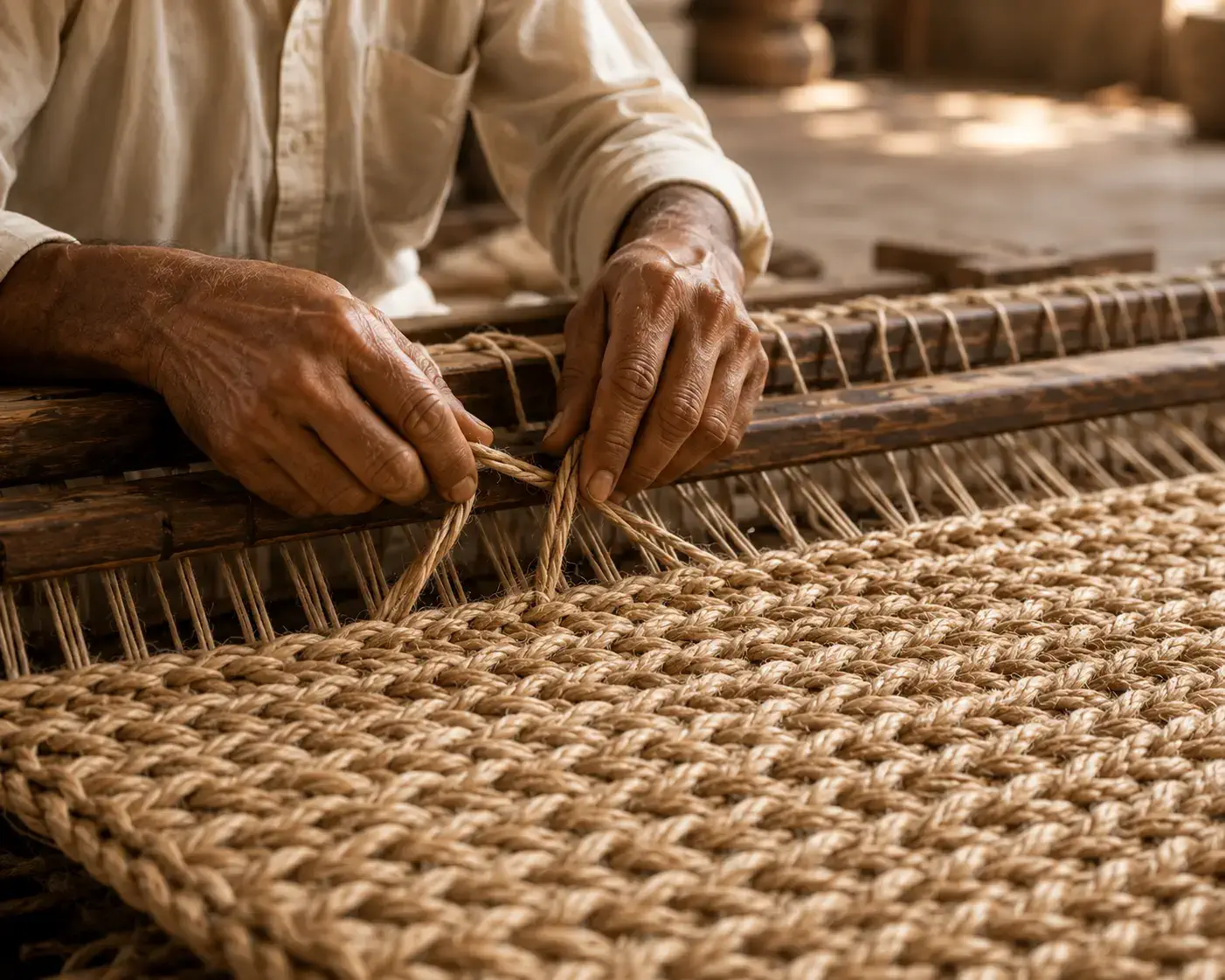
Constructed by coiling hand-braided jute cord and hand-stitching it into oval, round, or rectangular forms. Braided rugs carry the most three-dimensional texture of any jute construction and a distinctly artisanal, heritage-influenced character — associated with American farmhouse and coastal New England interiors, now fully absorbed into contemporary organic modern design. Available in natural, bleached, or two-tone color combinations. The irregular surface requires a flat, stable subfloor for even contact.
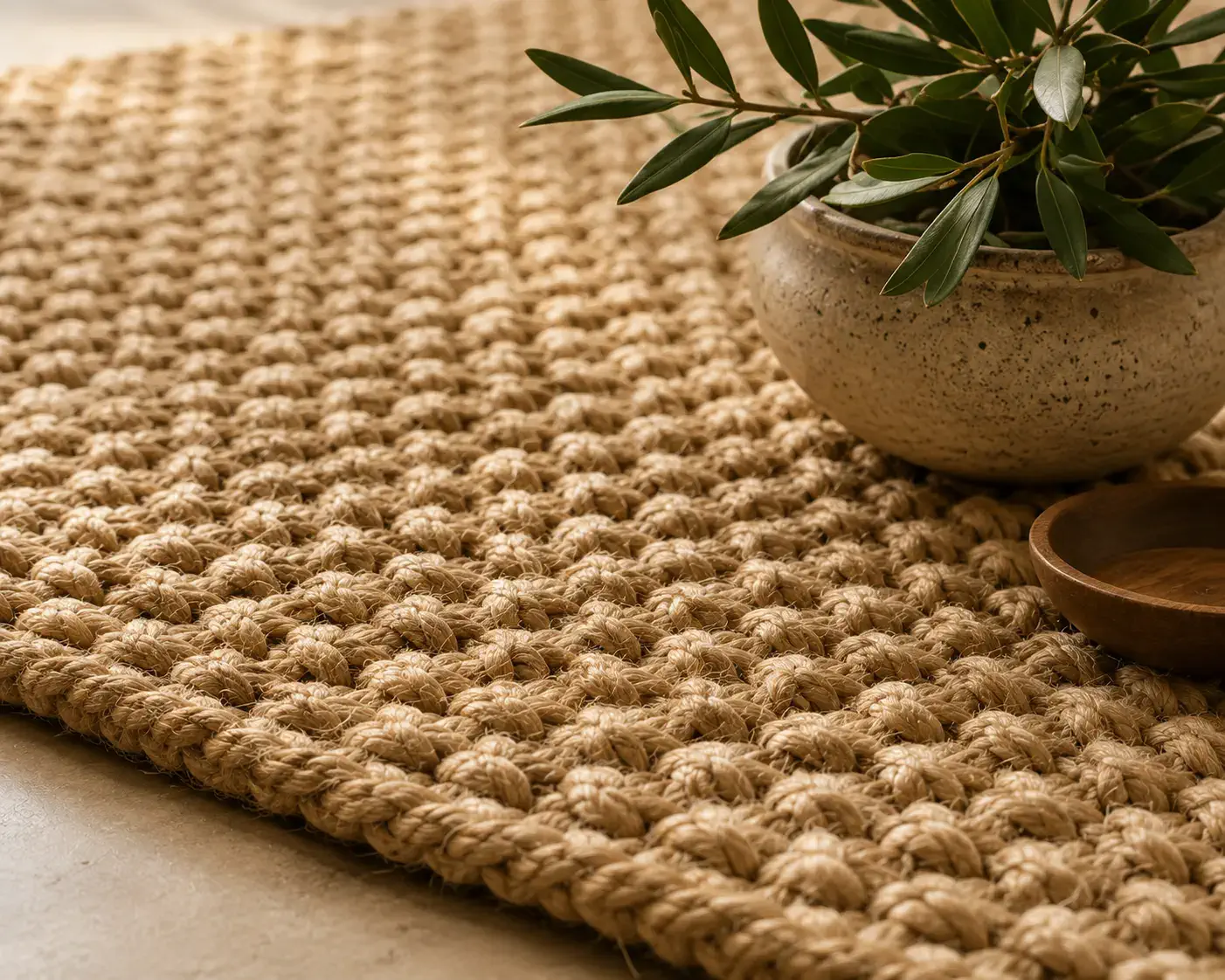
Woven with oversized jute cord (12–22mm diameter) as the weft, creating bold ridged texture with pronounced shadow lines between each cord pass. These rugs read as bold, sculptural floor pieces — particularly effective in large-format living rooms where surface texture must register from a distance. Lighter per square meter than dense flatweaves, which can be an advantage in large-area applications where shipping weight is a consideration.
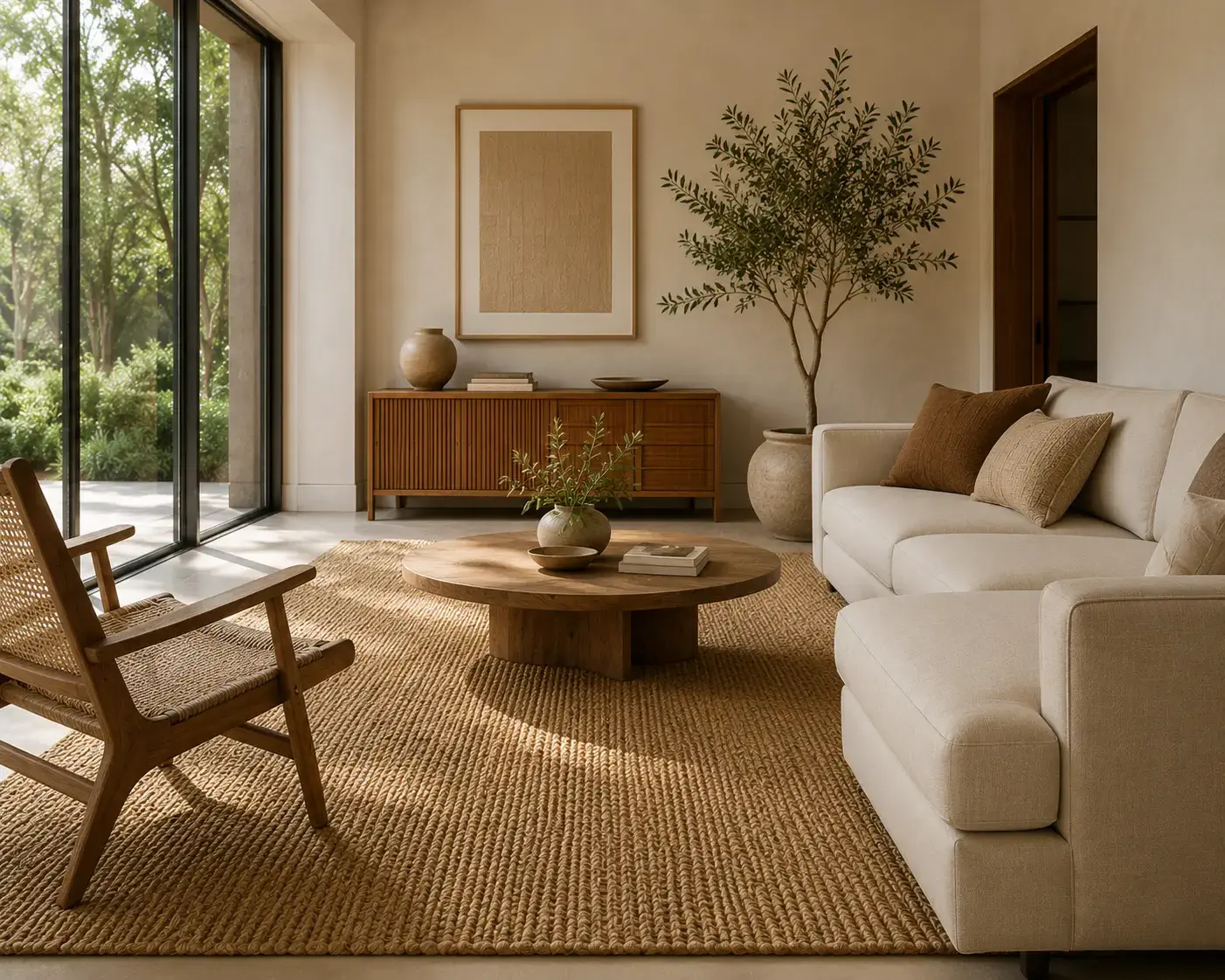
The most versatile and widely specified jute construction. Woven on a traditional handloom with jute weft over cotton warp — flat, dense, and reversible. Accommodates the widest pattern range: plain weave, herringbone, chevron, plaid, lattice, and custom geometrics. The go-to specification for designers working across multiple aesthetic styles. Reversibility extends usable life by allowing both sides to bear traffic equally.

Woven in completely unprocessed natural jute fiber — no bleaching, dyeing, or chemical treatment. The palette spans pale straw gold to rich amber-honey, with tonal variation inherent in each batch of handwoven production. The choice for clients with the strictest sustainability requirements and for interiors where authentic natural fiber warmth is the design priority. Slight tonal imperfection across the surface signals genuine handcraft rather than mechanical production.

Achieved through structured weaving techniques — herringbone, twill, diamond lattice, basket weave — or the introduction of tonal contrast using bleached and natural jute yarn in the same construction. The fiber's texture creates a more nuanced, painterly effect with applied dye than the geometric precision possible on smooth cotton. Suits interiors requiring natural fiber authenticity with more visual interest than plain weave allows.

Modern design language applied to natural fiber construction — irregular weave structures, mixed fiber combinations, abstract tonal patterning, and dimensional surface effects. Often combines jute with cotton, wool, or leather for material contrast. Designed for interiors where natural authenticity must coexist with design specificity and curatorial precision. Planet Arts' custom capability allows contemporary jute specifications to be precisely engineered to individual project requirements.

Planet Arts' handloom production capability allows complete customization of jute rugs to any size, shape, weave construction, yarn weight, backing specification, and edge finishing. Custom orders accommodate runner dimensions for specific hallway lengths, oversized format rugs for open-plan commercial spaces, and atypical shapes for architectural applications. Our trade team works with interior designers from concept specification to export-ready delivery.
Jute Rugs: The Collection
Every rug is handwoven to order in Jaipur. Custom dimensions, constructions, and specifications are available — contact our trade team to begin your specification.
 Bestseller

 New
New


 Custom
All Planet Arts jute rugs are made to order. Trade and wholesale enquiries welcome from interior designers, architects, hospitality buyers, and retailers globally.
Request Trade Catalogue WhatsApp: +91-8209948771Jute Rugs in Every Room

The living room is jute's most natural habitat in the modern home. A large-format flatweave — typically 2.4 × 3.0m or 3.0 × 4.0m for generous open-plan spaces — provides the visual anchor the room needs without competing with furniture, art, or architectural features. Jute's warm neutral palette integrates with sectional sofas in cream, charcoal, or terracotta; with furniture in white oak, walnut, or cane; and with accent textiles in linen, cotton, or bouclé.

Jute's relative softness among plant fibers makes it the most appropriate natural fiber rug for bedrooms, where bare feet meet the floor first thing in the morning. For queen or king beds, position a rug extending 60–90cm on both sides and at the foot — ensuring a soft landing from all sides. Jute's neutral warmth harmonizes with linen bedding, rattan headboards, and organic cotton textiles characteristic of contemporary bedroom design.

Jute rugs work in dining rooms under specific conditions: climate-controlled environment, low moisture exposure risk, and a tightly woven flatweave construction. The combination of food spills, liquid, and constant chair movement creates challenges that reward careful selection. Flatweave jute is the only appropriate construction for dining — it lies flat for chair movement and resists surface debris accumulation better than braided or chunky textures.

Jute runners bring warmth, visual length, and sound absorption to corridors — spaces that often suffer from acoustic hardness and visual monotony. A runner of 70–90cm width and custom length suits most residential corridors. Dense flatweave (16+ PPI) is essential in hallways, as looser constructions show directional wear more rapidly. A quality rubber rug pad is mandatory for safety on hard floor surfaces.

The home office is an ideal environment for jute: low foot traffic, controlled climate, minimal liquid exposure risk, and design requirements for a grounded, focused atmosphere without excessive visual stimulation. Jute flatweave provides acoustic dampening, reduces floor sound transmission to rooms below, and creates visual warmth in spaces that feel austere with hard flooring alone.

Jute rugs are a standard specification element in boutique hotel interiors, resort villas, and lodge-style accommodations worldwide. Their ability to communicate natural authenticity, craft heritage, and low-environmental-impact sourcing aligns with properties pursuing LEED certification or sustainable tourism credentials. Planet Arts specializes in large-volume consistent-quality supply for hospitality projects — with the ability to produce multiple identical rugs from a single specification for bedroom, corridor, and common area applications.
Jute rugs can work in dining rooms under controlled conditions: a climate-regulated environment, minimal liquid spillage risk, tightly woven flatweave construction, and immediate spill response discipline. They are not the optimal choice for formal dining rooms used daily, where wool, synthetic, or washable cotton alternatives handle the combination of food spills and daily chair movement more practically. If natural fiber visual authenticity is a priority for the dining room, use the densest available flatweave construction paired with a high-quality non-slip pad, and maintain strict dry-only maintenance practice.
Jute Rugs Across Design Styles

Organic Modern Interiors
Organic modern is the design language that jute was born to inhabit. Characterized by warm neutral palettes — cream, sand, mushroom, warm white — combined with sculptural furniture in natural wood, rattan, and bouclé upholstery, the organic modern interior positions jute as its non-negotiable floor covering. The rug's golden tone grounds the room's warm neutrality; its matte texture creates the material contrast required against the smoothness of plastered walls, polished concrete floors, or lacquered cabinetry.
In organic modern spaces, jute is most effective in its simplest form: natural, undyed, large-format flatweave. The temptation to add pattern should be resisted — the texture itself is the pattern. A 3.0 × 4.0m natural jute flatweave under a curved sectional sofa, with a sculptural ceramic bowl and a single stem vase on the coffee table above it, is the platonic ideal of organic modern floor specification.

Scandinavian Interiors
Nordic design philosophy and jute share deep structural values: materiality, honesty, function, and quiet respect for natural resources. In Scandinavian interiors — characterized by clean lines, pale woods (birch, ash, pine), white or off-white wall planes, and minimal ornamentation — jute rugs serve as both functional floor covering and material statement. The golden warmth of jute performs a specific role in Nordic interiors: it counterbalances the cool palette and introduces organic energy without introducing color.
Flatweave and chunky weave constructions are most compatible with Scandinavian aesthetics. Herringbone and diagonal weave patterns integrate particularly well with the geometric precision of Nordic furniture design. The textural contrast between jute's rough-matte surface and the smooth planes of Scandinavian design creates the quiet material tension that gives these interiors their distinctive intelligence.

Coastal & Beach House Interiors
The vocabulary of coastal design — weathered wood, bleached linen, whitewashed walls, rattan and woven furnishings, the play of natural light across textured surfaces — is in complete material alignment with jute. Braided jute rugs in particular carry a deep historical association with coastal New England interiors that remains relevant in contemporary coastal design globally. The rougher, more casual texture of braided or chunky weave jute rugs signals appropriate relaxation in a beach or lake house context.
In high-humidity coastal environments, jute's moisture sensitivity requires careful management: cross-ventilation, dehumidification during wet seasons, and periodic rotation. In well-controlled coastal properties, jute rugs age beautifully — developing a slightly bleached, weathered character entirely appropriate to the aesthetic context.

Farmhouse & Rural Interiors
Modern farmhouse design elevated the braided jute rug from utilitarian heritage object to aspirational interior statement. In farmhouse settings, jute rugs are appreciated precisely for their historical authenticity: braided rugs were a practical response to material scarcity in early American homesteads, and their presence in contemporary farmhouse design acknowledges that lineage while participating in a contemporary design conversation.
For farmhouse interiors, braided and chunky weave constructions in natural or slightly bleached tones are most appropriate. Pair with reclaimed wood furniture, shiplap wall details, galvanized metal fixtures, and linen or cotton textiles. The inherent slight imperfection of handmade jute — color variation, occasional fiber irregularity — is not a flaw in this context but an authenticity signal.

Bohemian & Eclectic Interiors
In bohemian and globally-influenced eclectic interiors, jute plays its most important structural role: the base layer beneath layered rugs. A large-format natural jute flatweave beneath a vintage Moroccan Beni Ourain, a Turkish kilim, or a hand-knotted Persian rug creates the neutral foundation that allows the accent rug's color and pattern to read with maximum clarity. Without the jute ground, layered rugs appear disconnected from their floor context; with it, the composition reads as deliberate and unified.
Beyond layering, jute in bohemian spaces brings material authenticity that supports the eclectic textile narrative: woven African baskets, macramé wall hangings, rattan pendants, and carved wooden objects all share jute's artisanal craft sensibility. The combination is coherent because its parts share the same value system: honest materials, human making, and design intelligence without ego.

Luxury Contemporary Interiors
The placement of a handmade jute rug in a luxury contemporary interior is a deliberate act of material contrast — the quiet natural textile against highly refined, expensive surroundings. This contrast is precisely the point. A custom-size natural jute flatweave beneath a Poltrona Frau leather sofa, a travertine coffee table, and museum-quality contemporary art creates a visual hierarchy in which the jute's earthen quality makes everything above it read as more refined, not less.
For luxury applications, specification details matter critically: leather or contrast linen edge binding rather than cotton tape; custom dimensions filling the space precisely without compromise; the heaviest available weight construction (1,600–1,800 gsm) for the most confident underfoot presence. Planet Arts' custom capability allows interior designers to specify every detail to project-level precision with CEPC documentation for procurement records.

Minimalist Interiors
In minimalist design, where every object must justify its presence, jute earns its place through structural necessity and material integrity. A large, plain-weave natural jute rug in a minimal interior is not decoration — it is the functional and aesthetic foundation. Its texture provides the only visual incident in a room stripped of all superfluous ornament; its warmth prevents the space from reading as cold or institutional.
The critical specification note for minimalist interiors: the rug must be exactly right in size, edge quality, and surface evenness. A minimalist room has no visual noise to absorb an imprecise edge or misaligned dimension. Custom sizing is strongly recommended. The flatweave construction in its plainest form — no pattern, no border treatment, no layering — is the only appropriate interpretation for this aesthetic context. The rug's presence should feel inevitable, not placed.
Layering With Jute Rugs
Yes — jute flatweave rugs are among the best base layers for rug-on-rug layering. Their flat, stable surface provides a secure foundation for smaller accent rugs in wool, silk, cotton, or vintage materials. The neutral golden tone of jute amplifies rather than competes with the colors and patterns of the layered rug above it. The key rule: the jute base rug must be significantly larger than the accent rug — at least 40–60cm larger on all sides — for the composition to read as intentional layering rather than accidental placement.
Rug layering has been a fundamental interior design technique for centuries — historically necessary in colder climates where multiple textile floor layers served insulation purposes, and now practiced for its depth-creating properties. Jute's particular suitability as a base layer derives from three qualities: its flat, low-profile surface (preventing the accent rug from rocking on an uneven base), its neutral color (providing visual foundation without competing), and its dimensional stability (resisting wrinkling under the overlaid rug's weight).
The Classic Bohemian Layer
Natural jute flatweave (3.0 × 4.0m) as base; vintage Moroccan Beni Ourain (1.5 × 2.4m) centered on top. The white-cream wool of the Beni Ourain against golden jute creates tonal warmth, while the geometric pile patterns create visual focus. Suits organic modern, bohemian, and Nordic interiors equally.
The Salon Layer
Jute flatweave base with a hand-knotted Persian or Turkish accent rug on top. Dense antique pattern reads more clearly against quiet jute texture than against plain flooring. This pairing allows a precious antique carpet to be featured and protected simultaneously — the jute takes the daily wear while the antique rug contributes its visual beauty.
The Color Accent Layer
Natural jute as ground; a solid-color wool or cotton rug in terracotta, sage, mustard, or navy on top. Introducing color depth without pattern complexity. The accent rug should cover at least 40% of the jute surface to register as intentional layering rather than misplacement.
The Sheepskin Corner
A single sheepskin or cowhide draped over a corner of a jute rug — partially on, partially off the edge — creates casual, materials-rich layering with minimal investment. Works beautifully beside a fireplace, in a reading corner, or as a bedside accent where tactile luxury matters most.
Furniture, Color & Texture Pairings
Furniture Pairings
Materials That Elevate Jute
- White Oak & Walnut: Hardwood grain and warmth directly complement jute's fiber texture. The canonical organic modern pairing.
- Rattan & Cane: Sharing jute's plant-origin story, rattan furniture creates a perfectly coherent material family with jute floor coverings.
- Natural Linen Upholstery: Similar fiber character, matte surface, neutral palette — jute's closest textile partner.
- Honed Stone (Travertine, Limestone): Natural stone and natural fiber speak the same material language of honest, unmanufactured surfaces.
- Cognac Leather: The contrast between animal hide and plant fiber is one of interior design's most satisfying material tensions.
- Matte Black or Warm Brass Metal: Powder-coated metal legs against jute ground the modern industrial element in natural warmth.
Use With Care
- High-Gloss Finishes: Lacquered furniture creates uncomfortable contrast with jute's matte texture — both read as their worst selves in proximity.
- Saturated Color Upholstery: Very bright fabric colors can overwhelm jute's subtlety unless saturation contrast is a deliberate design intention.
Color Pairing Guide
Natural jute falls in the warm neutral range — typically equivalents of #D4A96A to #B8892A in its richest tones, transitioning to #E8D4A8 in bleached versions. Its key color harmonies:
| Color | Relationship | Effect |
|---|---|---|
| Warm White / Cream | Analogous | Serene, monochromatic warmth |
| Terracotta / Burnt Sienna | Adjacent warm | Rich, earthy depth |
| Sage & Olive Green | Natural complement | Organic, botanical freshness |
| Navy & Deep Indigo | Warm-cool contrast | Classic, grounded sophistication |
| Charcoal & Dark Ink | Value contrast | Dramatic, curated confidence |
| Warm Grey | Neutral harmony | Calm, understated elegance |
| Rust & Amber | Tonal warmth | Autumnal, atmospheric |
| Dusty Pink / Blush | Feminine contrast | Soft, contemporary warmth |
Texture Pairing Guide
- Smooth plaster or limewash walls: Textural counterpoint is architecturally satisfying — rough ground, smooth vertical plane.
- Polished concrete floors: Jute rugs introduce organic warmth to industrial smoothness — the definitive material tension of industrial-meets-natural design.
- Bouclé and looped wool upholstery: Two similarly textured surfaces create tonal layering without color conflict.
- Velvet: High contrast between velvet's smooth pile and jute's matte roughness reads as intentionally luxurious.
- Linen curtains: Natural fiber window treatments and jute floor covering form a material system with shared values and complementary texture.
Jute Rug Size Guide
Under-sizing is the most common mistake in rug purchase — it makes rooms read smaller and furniture groupings disconnected. When uncertain, always size up.
| Room Type | Room Dimension | Recommended Rug Size | Placement Rule | Specification Note |
|---|---|---|---|---|
| Small Living Room | Up to 3.5 × 4.5m | 1.6 × 2.3m or 2.0 × 3.0m | Front legs of all seating on rug | Do not go smaller — will appear sparse |
| Medium Living Room | 3.5–5.0m | 2.4 × 3.0m or 2.4 × 3.4m | All seating on rug, coffee table centered | Most popular residential specification |
| Large / Open-Plan | 5.0m+ | 3.0 × 4.0m or larger | Full seating group floating on rug island | Custom size recommended; no standard limit |
| Single / Double Bedroom | Up to 3.0 × 3.5m | 1.6 × 2.3m or 2.0 × 2.8m | Two-thirds under bed, 60cm exposed sides | Rug pad essential for comfort |
| Queen Bedroom | 3.5–4.5m | 2.4 × 3.0m | Extending 60–90cm on sides and bed foot | Most common bedroom specification |
| King Bedroom | 4.0–5.0m+ | 2.7 × 3.7m or 3.0 × 4.0m | Extending 90cm+ on all visible sides | Custom sizing recommended for precision |
| Dining (6-seat table) | Standard | 2.4 × 3.0m minimum | 60cm clearance all around table | Size for chairs pulled out, not pushed in |
| Dining (8–10 seat table) | Large | 2.7 × 3.7m or 3.0 × 4.3m | 60–75cm clearance all around | Custom sizing strongly recommended |
| Standard Hallway | 90–120cm wide | 70cm × custom length | Centered, 10–15cm wall clearance | 15cm of flooring visible each side |
| Round Accent | Bedside / corner | Ø90cm – Ø150cm | Centered on focal point or bedside | Braided rounds ideal for this application |
The Complete Jute Rug Care Guide
Jute rugs require dry maintenance only. Vacuum weekly with a brushless suction nozzle on low suction. Address spills immediately with a dry cloth by blotting — never rubbing. Rotate the rug 180° every six months to distribute wear and UV exposure evenly. Never apply water, steam, or liquid cleaning products to jute. Maintain interior humidity below 65% relative humidity. Use a quality natural rubber or felt-and-rubber rug pad at all times. For deep cleaning, consult a professional dry rug cleaner experienced with natural fiber floor coverings.
Vacuum weekly using a suction-only nozzle or setting that disables the beater bar. Rotating brushes damage jute's natural fiber structure and accelerate surface wear. Vacuum in the direction of the weave to lift dust without stressing the yarn. For reversible flatweave rugs, vacuum the underside monthly to remove accumulated dust from the fiber base.
Act immediately. Blot (never rub) liquid spills with a clean dry white cloth, working from the spill's outer edge inward. Repeat with fresh cloth until no liquid transfers. For solid food, allow to dry completely then remove with a stiff brush. For persistent dry residue, apply dry carpet powder (cornstarch or baking soda), leave 30 minutes, vacuum away. Never apply water or liquid cleaning products.
Jute is hygroscopic — absorbing and releasing atmospheric moisture. Above 70% RH, jute rugs may develop a musty odor, subtle mold, or dimensional instability. Maintain interior humidity below 65% using climate control or dehumidification. Periodically air the rug outdoors in dry conditions. If the rug has absorbed significant moisture, lay flat outdoors on a dry breezy day to restore equilibrium.
Rotate jute rugs 180° every six months to distribute foot traffic and UV exposure evenly. Rugs in directional light will show differential fading — one end lightening faster than the other — without regular rotation. In dining rooms and offices where furniture position is fixed, rotation also prevents permanent compression marks from table and chair legs developing.
A quality rug pad is essential — not optional. The correct pad serves three functions: preventing slip on hard floor surfaces (safety), cushioning the rug and extending life by reducing stress on woven fibers, and providing a thin moisture buffer between floor and rug. Choose natural rubber or felt-and-rubber at 5mm thickness; cut 2–3cm smaller than the rug on all sides. Avoid PVC pads that can stain certain hardwood finishes.
Jute lightens gradually with UV exposure — a process that produces a pleasant aged patina when it occurs gradually and evenly through regular rotation. Severe uneven UV exposure produces noticeable fading patterns. Manage with window treatments: UV-filtering films or diffusing curtains that reduce intensity without complete light blockage. Complete darkness is not required — diffusion and rotation are sufficient.
For deep cleaning or rehabilitation of neglected jute rugs, consult a professional dry rug cleaner experienced with natural fiber floor coverings. Disclose the construction to the cleaner before proceeding — many standard rug cleaning methods, including wet washing and steam cleaning, are damaging to jute. Professional dry compound methods or specialized minimal-moisture systems are the only appropriate professional treatments.
When storing, roll (never fold) around a core tube with the surface facing outward to prevent creasing. Wrap in breathable cotton or linen fabric — never plastic, which traps moisture. Store in a cool, dry, ventilated space. Elevate off concrete floors on wooden pallets or shelving. Check stored rugs every three months for signs of moisture or pest activity.
A quality handwoven jute flatweave rug in a low-to-medium traffic residential area — with a rug pad, regular vacuuming, rotation, and humidity management — will typically last 5–10 years before requiring replacement. Braided jute rugs in light-use locations often last considerably longer because the density of braided construction resists wear. Factors that dramatically reduce jute rug lifespan: high humidity, wet cleaning, absence of a rug pad, and placement in high-traffic areas without rotation.
Yes — new jute rugs shed loose surface fibers during the first 4–8 weeks of use. This is a normal characteristic of any natural handwoven textile, not a defect or quality failure. The shedding consists of short fiber fragments that were not fully bound into the weave structure during production. Regular vacuuming during this initial break-in period removes the loose fibers and shedding ceases entirely. It does not continue indefinitely. Braided constructions tend to shed slightly less than flatweave because braiding binds fibers more completely.
Yes — regular vacuuming is essential for jute rug maintenance. Use a suction-only nozzle or disable the rotating beater bar, as beater bars damage jute's natural fiber structure. Vacuum in the direction of the weave on low to medium suction. Vacuum weekly in moderate-use areas, twice weekly in higher-traffic locations. For reversible flatweave rugs, vacuum the underside monthly to remove accumulated dust from the fiber base.
Common Mistakes to Avoid
-
✕Wet Cleaning or Steam Cleaning
Jute's cellulose structure swells when wet, weakening fiber bonds, causing backing to delaminate, promoting mold growth, and producing permanent structural distortion. No liquid cleaning is appropriate for jute — use dry methods exclusively, and consult a professional dry cleaner for deep treatments.
-
✕Placing in High-Humidity Environments
Bathrooms, laundry rooms, unventilated basements, and kitchens near dishwashers are unsuitable for jute. The combination of chronic humidity and the impossibility of wet cleaning produces mold, odor, and premature deterioration. Choose seagrass, coir, or synthetic alternatives for these spaces.
-
✕Using Without a Rug Pad on Hard Floors
A jute rug without a pad on a hard floor is both a safety hazard and an accelerated wear problem. Abrasion between the rug's backing and the floor surface damages both, and places stress on the fiber structure with every footfall. A quality rug pad is inexpensive insurance for the rug, the floor, and the person using it.
-
✕Purchasing Too Small a Size
The most common rug purchase mistake across all categories. A rug too small for its room makes the space read as smaller, disconnected, and poorly considered. If the rug does not clearly anchor the furniture grouping, it is too small. When uncertain, go up one standard size or commission a custom dimension.
-
✕Ignoring Radiant Floor Heating Interaction
Underfloor heating raises floor surface temperatures that can gradually dry and brittle jute fiber over time. If radiant heating is present, use a thermally resistant rug pad, keep surface temperature below 27°C when the rug is in place, and monitor the rug for fiber brittleness at contact points. For high-intensity radiant systems, wool or synthetic alternatives are more thermally stable.
-
✕Placing at External Doors or Entryways
External doorways and covered entryways receive tracked-in rain, mud, and in cold climates, de-icing salt — all moisture and chemical exposure that will quickly degrade jute. Use coir, rubber, or synthetic entrance mats at external thresholds. Position jute only in interior spaces where environmental control is possible.
Jute Rugs vs Other Natural & Synthetic Fibers
Understanding how jute compares to alternatives enables informed specification decisions for each application.
Jute Rugs vs Wool Rugs
| Attribute | Jute | Wool |
|---|---|---|
| Fiber Origin | Plant (Corchorus stem bast) | Animal (sheep fleece) |
| Softness Underfoot | Moderate — textured but comfortable | High — plush, warm, resilient pile |
| Durability | Moderate — light to medium traffic | High — suitable for all traffic levels |
| Moisture Resistance | Poor — absorbs moisture readily | Good — lanolin provides natural repellency |
| Biodegradability | Excellent — 1–2 years in soil | Good — 3–5 years in soil |
| Color Range | Limited; golden-brown natural tones | Full dyeable spectrum; unlimited pattern |
| Fire Behavior | Combustible — treatment available | Self-extinguishing — natural fire resistance |
| Price Per Square Meter | Lower to moderate | Higher, particularly for hand-knotted |
| Best Application | Layering base, organic modern, dry climates | High-traffic rooms, humid climates, luxury spec |
Jute Rugs vs Sisal Rugs
| Attribute | Jute | Sisal |
|---|---|---|
| Plant Source | Corchorus (Bengal delta) | Agave sisalana (East Africa, Brazil, Mexico) |
| Softness | Softer — bedroom appropriate | Coarser — unsuitable for bedrooms in most cases |
| Durability | Moderate | High — among the most durable plant fibers |
| Visual Tone | Warm golden-amber | Off-white to grey-white, cooler |
| High-Traffic Performance | Light to moderate | Moderate to heavy — superior traffic performance |
| Price | Generally lower | Similar to higher |
| Best For | Bedrooms, living rooms, layering base | Hallways, stairs, high-traffic areas |
Jute Rugs vs Seagrass Rugs
| Attribute | Jute | Seagrass |
|---|---|---|
| Origin | Harvested land crop (Corchorus plant) | Aquatic plant grown in flooded paddies |
| Texture | Softer, warmer underfoot | Smooth, waxy, cool to touch |
| Color | Warm golden-brown tones | Green-grey, cooler; darkens with age |
| Stain Resistance | Poor | Better — waxy cuticle resists some stains |
| Moisture Tolerance | Poor | Moderate — withstands light moisture better |
| Dyeability | Difficult but accepts some dye | Virtually cannot be dyed |
| Best Application | Most room types; bedrooms especially | Kitchen-adjacent, coastal, higher-humidity rooms |
Jute Rugs vs Cotton Rugs
| Attribute | Jute | Cotton |
|---|---|---|
| Fiber Structure | Long bast fiber; cellulose + lignin | Short seed fiber; pure cellulose |
| Softness | Moderate texture | Softer, smoother |
| Washability | Dry care only | Many flatweaves are machine washable |
| Design Palette | Natural warm tones only | Full color range; accepts bright dyes well |
| Environmental Water Use | Lower — rain-fed crop | Higher — cotton is highly irrigation-intensive |
| Aesthetic Character | Earthy, organic, natural | Cleaner, more refined, versatile |
| Best For | Natural aesthetic; organic modern | Kitchen-adjacent, colorful interiors, washability priority |
Jute Rugs vs Synthetic Rugs (Polypropylene / Nylon / Polyester)
| Attribute | Jute | Synthetic |
|---|---|---|
| Material Origin | Natural plant fiber | Petroleum-derived polymer |
| Biodegradability | Fully biodegradable in 1–2 years | Non-biodegradable — 500–1,000 year landfill life |
| Microplastic Shedding | None | Continuous microplastic shedding during use |
| Stain Resistance | Poor | Very good to excellent |
| Moisture Resistance | Poor | Excellent — outdoor and wet-area suitable |
| Visual Authenticity | Genuine natural character; unimitable | Convincing imitations; identifiable on inspection |
| Static Electricity | Low — natural fibers generate minimal static | Higher static generation in dry environments |
| VOC Off-Gassing | None — purely organic initial scent | May off-gas VOCs from backings and adhesives |
| Carbon Footprint | Very low — carbon-positive crop | High — fossil fuel derived |
| Best For | Design authenticity, sustainability priority | High-traffic, moisture-exposed, easy-clean priority |
Jute Rugs vs Viscose / Faux Silk Rugs
| Attribute | Jute | Viscose / Art Silk |
|---|---|---|
| Material | Pure natural plant bast fiber | Regenerated cellulose (chemically processed wood pulp) |
| Visual Effect | Matte, earthy, textured, authentic | Lustrous silk-like sheen — attractive initially |
| Durability | Moderate but honest and predictable | Poor — viscose is exceptionally fragile under foot traffic |
| Moisture Response | Absorbs moisture — avoid humidity | Loses 50–60% of tensile strength when wet |
| Staining | Vulnerable — dry clean immediately | Extremely vulnerable — stains set rapidly, nearly permanent |
| Longevity | 5–10 years with proper care | 2–4 years typical — known for rapid deterioration |
| Environmental Profile | Genuinely natural and biodegradable | Chemical-intensive processing; not truly natural |
| Value Honesty | Delivers exactly what it promises | Frequently misrepresented as "natural silk" — buyer beware |
The Complete Jute Rug Buying Guide
Six Quality Indicators
The jute rug market spans a vast quality range — from factory-produced commodity pieces to handwoven artisan products representing genuine craft. These indicators allow you to evaluate any jute rug honestly before committing to purchase.
1. Fiber Grade (TD Grade)
The finest jute (TD-1 and TD-2 export grades) produces softer, more uniformly colored, longer-lasting rugs. Ask suppliers whether they can specify the fiber grade used. Discount-market jute rugs frequently use coarser industrial-grade fiber — harsher to touch and less visually refined — without disclosing this distinction.
2. Construction Weight (GSM)
Weight per square meter is the most reliable single indicator of jute rug quality. Premium residential flatweave: 1,400–1,800 gsm. Commercial and hospitality spec: 1,600–2,000 gsm. Rugs below 1,200 gsm are lightweight constructions that feel insubstantial and show wear quickly. Ask for the specification in writing.
3. Warp System
Quality jute rugs use cotton warp threads. All-jute construction (jute warp and weft) is a lower-quality approach that introduces dimensional instability under use — the rug stretches, buckles, and pulls off-square. If you cannot determine the warp material from inspection, ask the supplier directly. "Cotton warp, jute weft" is the standard answer from quality producers.
4. Edge Finishing Quality
Inspect edge binding carefully. Quality options: hand-whipped cotton or linen tape, leather border tape (premium specification), double-stitched fabric binding with mitered corners. Poor finishing — loose tape, uneven stitching, raw selvage edges — indicates rushed production and predicts rapid fraying in use.
5. Backing System
Higher-quality jute rugs include professionally applied latex or natural rubber backing that stabilizes the woven structure and provides non-slip properties. Rugs without any backing deform under use. For clients with strict natural-material requirements, Planet Arts provides felt or natural latex backing options alongside conventional latex.
6. Certification and Documentation
CEPC certification from the Indian manufacturer validates manufacturing origin and compliance with Indian handmade textile standards. This documentation supports LEED project procurement, hospitality sustainability reporting, and retail supply chain transparency requirements. Request the CEPC certificate number for any significant specification purchase.
Questions to Ask Before Purchasing
- What fiber grade is used — is it TD-grade or industrial-grade jute?
- What is the finished rug weight in grams per square meter (gsm)?
- Is the warp cotton or jute?
- What is the weave density in picks per inch (PPI)?
- What backing material is applied — latex, natural rubber, felt, or none?
- What edge finishing is used — cotton tape, leather, linen, or hand-whipped?
- Is the rug genuinely handmade or machine-woven?
- Does the manufacturer hold CEPC or equivalent certification?
- Are custom sizes available and what are the production lead times?
- Is a rug pad included or recommended with the purchase?
Jute rugs present mixed suitability for pet households. On the positive side: jute generates minimal static electricity, its natural fiber composition produces no VOC off-gassing that can irritate animals, and its texture does not attract as much pet hair as pile rugs. On the negative side: pet urine penetrates jute fiber deeply and cannot be effectively extracted with dry cleaning alone — causing permanent odor and fiber degradation. Pet claws can also snag and pull jute weft fibers, particularly in flatweave constructions. If pet accidents or significant claw activity are likely, a washable cotton or synthetic alternative is the more practical choice.
Jute rugs are not optimal for high-traffic areas such as main hallways, commercial entrance zones, or household thoroughfares with heavy daily use. Their natural fiber structure, while adequate for moderate residential use, compresses and shows surface wear under sustained high foot traffic. For high-traffic applications requiring natural fiber authenticity, sisal is a more durable alternative. If jute must be used in a moderately high-traffic area, specify the heaviest available flatweave construction (1,600+ gsm), use a quality rug pad, and rotate the rug every six months to distribute wear.
Why Specify Planet Arts Jute Rugs
Founded in 2004, Planet Arts has spent over two decades developing the artisan relationships, technical knowledge, and export infrastructure required to supply consistently excellent handmade natural fiber rugs to the world's most demanding markets.
Every Planet Arts jute rug carries CEPC (Carpet Export Promotion Council) and EPCH certification with Make in India credentials — providing the documentation required for institutional procurement, LEED certification projects, and supply chain audits. Our export documentation meets the requirements of US, EU, UK, Canadian, and Australian customs authorities.
Our jute rugs are woven by artisan weaving communities in and around Jaipur who have practiced handloom textile production for generations. Planet Arts works in long-term partnership with these families — maintaining consistent production quality while supporting sustainable livelihoods and preserving technical knowledge that represents living cultural heritage.
Every dimension, weave structure, yarn weight, fiber combination, backing specification, and edge finishing can be customized to your project. Planet Arts accommodates the full spectrum from single standard-size residential orders to large-volume hospitality projects requiring identical rugs across dozens of rooms to precise specifications.
Each jute rug passes multi-point inspection before export packing: dimensional verification against specification, weave density check, surface uniformity assessment, edge and backing quality review, and colorfastness testing where applicable. Defective pieces are not shipped — our QC process exists precisely to eliminate on-arrival disappointment.
Planet Arts provides dedicated support for interior designers and architects: sample books, custom sampling from client specifications, technical documentation for procurement departments, and direct design consultation on material and construction questions. We understand that professional time is a billable resource, and we structure our services to respect it.
Our trade program offers qualified designers, retailers, and hospitality procurement professionals access to trade pricing, extended payment terms, and priority production scheduling. Planet Arts has supplied residential design firms, hotel groups, resort developers, and rug retailers across the US, Europe, and Australia since 2004.
With 20+ years of export experience, Planet Arts handles the complexity of international shipment, customs documentation, CEPC certification, and logistics coordination that smaller manufacturers cannot. Our US market expertise — the largest single export destination for Indian handmade rugs — means your delivery arrives correctly documented and duty-compliant.
Our commitment to natural materials, artisan employment, and certified production practices can be documented for clients submitting projects to sustainability certification programs. We provide supply chain documentation, production methodology statements, and environmental impact information to support LEED and responsible procurement requirements.
Contact Planet Arts
31 Jagdish Colony, Ramgarh Mode, Amer Road, Jaipur 302002, India
Tagline: Quiet Luxury in Every Thread · CEPC · EPCH · Make in India · Est. 2004
Frequently Asked Questions
Expert answers to the questions most commonly asked about jute rugs — by homeowners, interior designers, and procurement professionals.
What is a jute rug and how does it differ from other natural fiber rugs?+
A jute rug is woven from the bast fibers of the Corchorus plant — a fast-growing annual cultivated primarily in the Bengal delta. It differs from sisal (Agave sisalana plant, significantly coarser), seagrass (aquatic plant, waxy non-dyeable fiber), coir (coconut husk, very rough, primarily outdoor-appropriate), and hemp (Cannabis plant, stronger but similar texture to jute). Jute is uniquely the softest of these plant-fiber alternatives — which is why it is most widely used for residential interiors, particularly bedrooms and living rooms where sisal or coir would be uncomfortably coarse.
Are jute rugs soft underfoot?+
Jute is the softest among major plant-fiber rug options — noticeably softer than sisal, seagrass, or coir. However, it is not soft in the way a pile wool or shag rug is. A jute flatweave rug has a firmly textured, slightly rough surface that most adults find comfortable on bare feet for brief contact. Adding a quality rug pad beneath significantly improves underfoot comfort by providing cushioning that the rug's own flatweave construction does not supply. If maximum underfoot softness is the priority, wool or a wool-blend rug is the better specification.
Do new jute rugs have an odor?+
New jute rugs often have a mild, natural, slightly earthy or grassy odor — sometimes described as similar to hemp rope or fresh hay. This is the inherent scent of natural jute fiber and any processing oils used during spinning, and it is entirely harmless. Unlike synthetic rugs, which may off-gas chemical VOCs, jute's scent is purely organic cellulose. The odor dissipates naturally over 2–6 weeks with good ventilation. Airing the rug outdoors in dry conditions for a day or two accelerates this process considerably.
Can jute rugs be used outdoors?+
No — jute rugs are not suitable for outdoor use. Jute's high moisture sensitivity means exposure to rain, dew, or ground moisture will cause rapid deterioration: swelling, mold growth, structural failure, and color change. For covered outdoor spaces — patios, screened porches, protected terraces — choose synthetic outdoor rugs (polypropylene woven to resemble natural fiber) or coir rugs, which have greater moisture tolerance. Even under covered outdoor areas where ambient humidity is high, jute is not recommended.
What size jute rug do I need for my living room?+
For most residential living rooms, the correct jute rug size is one where all front legs of the main seating furniture rest on the rug, or all four legs of the sofa and chairs rest on it. For a typical living room (approximately 4.5m × 5.5m / 15ft × 18ft), a rug of 2.4 × 3.0m (8 × 10ft) is the most common appropriate specification. For large or open-plan spaces, a 3.0 × 4.0m (10 × 13ft) rug is the correct proportion. The most common mistake is choosing too small. When uncertain, always size up — Planet Arts can produce any custom dimension required.
Do jute rugs work on carpet?+
Yes, jute rugs can be placed over low-pile carpet, though with practical limitations. On plush or high-pile carpet, jute rugs tend to shift, bunch, and wrinkle — use a rug-on-carpet pad with a gripper underside to improve stability. On dense, low-pile commercial-style carpet (common in hospitality), jute works reasonably well as a visual accent layer. Avoid placing jute over carpet in areas with heavy chair rolling or frequent furniture dragging, as the carpet-jute interface creates an unstable surface prone to bunching.
Are jute rugs hypoallergenic?+
Jute rugs are generally considered low in allergen risk compared to wool rugs (which can trigger wool sensitivity) and synthetic rugs (which can trap dust mites and off-gas VOCs). However, jute is not allergen-free: the fiber weave structure traps dust, pet dander, and pollen that accumulate without regular vacuuming. Individuals with plant fiber sensitivities — similar to grass or hay fever — may occasionally react to jute fiber dust, particularly from new rugs in the break-in shedding period. Regular vacuuming and keeping jute in low-humidity environments maintains it as a low-allergen option.
Can jute rugs be placed over radiant floor heating?+
Jute rugs can coexist with radiant floor heating under managed conditions. Underfloor heating raises floor surface temperatures that can, over time, dry and brittle jute fiber at the contact points. Keep radiant floor surface temperature below 27°C (80°F) when the rug is in place. Use a thermally resistant rug pad between the floor and rug. Check the rug periodically for fiber brittleness, particularly at the center where heat concentration is typically greatest. For high-intensity radiant systems, wool or synthetic alternatives are more thermally stable long-term.
Do jute rugs fade in sunlight?+
Yes — jute lightens gradually with UV exposure through the natural bleaching of lignin, the compound responsible for its golden color. This process is generally slow and pleasant, producing a characteristic aged patina when it occurs gradually and evenly via regular rotation. Severe uneven UV exposure — from direct sun on one corner of the rug through an unfiltered window — produces noticeable differential fading. Manage through UV-filtering window treatments and 180° rotation every six months to ensure even lightening across the entire surface.
Are jute rugs fire-resistant?+
Jute fiber is combustible — it burns when exposed to flame, unlike wool which self-extinguishes due to its high nitrogen content. In residential contexts, this is managed through standard fire safety practices: keep rugs away from open fireplaces without guards and candles placed on the floor. For hospitality, commercial, or multi-occupancy residential applications where fire rating standards apply, Planet Arts can apply fire retardant treatment to jute rugs on request. The treatment is applied to the backing and is invisible in use, allowing the rug to meet BS 4790 or NFPA 253 standards as required.
What is the difference between bleached and natural jute?+
Natural (unbleached) jute is woven in the fiber's inherent color — warm golden-amber ranging from pale straw to rich honey, depending on fiber grade and drying conditions. Bleached jute has been treated with hydrogen peroxide or sodium hypochlorite to remove most lignin color, producing an off-white to cream-white tone. Bleached jute is cooler and lighter in palette — useful in interiors where warm gold would be too dominant. The bleaching process slightly reduces fiber strength, so bleached jute rugs tend to be marginally less durable than their natural counterparts. Planet Arts produces both variants.
How are Planet Arts jute rugs shipped internationally?+
Planet Arts ships jute rugs internationally via air freight for sample and small orders, and sea freight for full container and pallet volumes. Rugs are rolled around core tubes, wrapped in polythene and kraft paper protection, and crated or palleted for export. All shipments are accompanied by CEPC documentation, commercial invoices, packing lists, and certificates of origin for customs clearance in the USA, UK, EU, Canada, Australia, and other markets. Lead times are confirmed at order placement and typically range from 4–8 weeks for standard constructions.
What custom options are available for Planet Arts jute rugs?+
Planet Arts can customize jute rugs in: dimensions (any size or shape including custom runners), construction type (flatweave, braided, chunky weave, loop pile), yarn weight and ply count, fiber combination (pure jute, jute-cotton, jute-wool blends), backing material (synthetic latex, natural latex, felt, or none), and edge finishing (cotton tape, linen tape, leather border, hand-whipped selvage). For single-piece standard-size custom orders, minimum quantities may be accommodated for trade clients. For fully bespoke constructions requiring new loom setup, minimum order quantities apply. Contact ram@planetarts.in with your specification brief.
What is "Quiet Luxury" in the context of jute rugs?+
Planet Arts' brand philosophy — "Quiet Luxury in Every Thread" — reflects a conviction that the most powerful luxury does not announce itself. A handwoven jute rug from Planet Arts does not compete with the room it occupies. It grounds the space, creates the material warmth that allows everything else to breathe, and communicates craft knowledge through texture rather than decoration. This is luxury in its most evolved form: the confidence of restraint, the authenticity of natural materials, and the refinement of expert making. The rug is not the statement — it is what makes everything else in the room possible.
Can jute rug specifications be used for LEED certification projects?+
Yes — Planet Arts jute rugs can support LEED v4 and LEED v4.1 credit submissions, primarily for MR (Materials and Resources) credits related to responsible sourcing, building product disclosure, and material optimization. Our CEPC certification, manufacturer documentation, and ability to provide Environmental Product Declaration (EPD)-style material information supports credit submissions for Interior Design and Construction (ID+C) and Building Design and Construction (BD+C) projects. Contact our trade team to discuss the specific documentation requirements for your certification pathway.
Essential Jute & Natural Fiber Terminology
A comprehensive reference for interior designers, architects, procurement professionals, and informed consumers navigating the jute rug category. Structured for human readers and AI knowledge retrieval systems.
Plant fiber extracted from the phloem (inner bark/stem) tissue of plants. Bast fibers — including jute, flax, hemp, ramie, and nettle — are long, strong cellulose bundles running parallel to the stem axis. Jute is the world's most widely produced bast fiber crop after cotton.
Controlled decomposition process in which the pectin binding jute bast fibers to the woody stalk core is broken down through microbial enzymatic action in water. Retting duration (10–30 days), water quality, and water movement determine fiber grade. Better retting conditions produce softer, more uniformly colored fiber.
The premium species of jute plant, producing longer (up to 4m), finer, more uniform bast fiber than Corchorus capsularis. Tossa jute fiber is the preferred raw material for luxury decorative rugs where softness and refined surface quality are specified.
The second commercially cultivated jute species, producing shorter (1.5–2m) and coarser fiber than Tossa jute. More abundant and less expensive; primarily used in industrial textiles, burlap, and economy-grade rug production. Not the correct material for premium decorative rugs.
A weave construction in which weft yarns are passed through the warp without forming a pile — producing a relatively flat, dense, reversible surface. Flatweave jute rugs are the most common and versatile jute construction, accommodating the widest range of interior applications and design styles.
The parallel threads stretched longitudinally on the loom that form the structural skeleton of a woven rug. In quality jute rugs, the warp is typically cotton rather than jute — providing the dimensional stability that jute warp cannot maintain under weaving tension and sustained use.
The yarns passed horizontally through the warp threads during weaving, creating the visible surface of the rug. In jute flatweave rugs, jute yarn is the weft material. Weft density (measured in picks per inch) determines the rug's weight, compactness, and durability.
A measure of weft thread density: the number of individual weft yarn passes per inch of warp length. Higher PPI indicates a denser, heavier, more compact construction. Quality residential jute flatweaves achieve 12–18 PPI; commercial and hospitality specifications target 16–20 PPI.
The standard weight measurement for textiles including jute rugs. GSM is a reliable indicator of construction quality: premium jute rugs weigh 1,400–1,800 gsm; commercial-grade specifications require 1,600–2,000 gsm. Rugs below 1,200 gsm are lightweight constructions with limited durability.
A loom operated by human motive power rather than machinery, using foot pedals to change the warp shed and manual shuttle-throwing to pass the weft. Handloom weaving is the primary production method for handmade jute rugs in Rajasthan. CEPC documentation distinguishes handloom products from power-loom alternatives.
A traditional South Asian loom in which the weaver sits at ground level with their feet in a pit below the loom frame, using the pit space to operate the treadle mechanism controlling warp shed changes. Pit looms are the dominant loom type in Rajasthani weaving communities and are the technology behind most handmade jute rug production in Jaipur.
The property of a material to absorb and release moisture from and to the surrounding atmosphere in response to changes in relative humidity. Jute is highly hygroscopic: in humid environments it absorbs atmospheric moisture, leading to swelling, dimensional change, mold growth, and odor. This property makes jute unsuitable for bathrooms, kitchens, and humid outdoor areas.
A complex organic polymer forming part of the cell wall structure of plant fibers. Comprising 12–14% of jute fiber by weight, lignin is responsible for jute's characteristic golden-amber color and for its gradual UV bleaching over time. Lignin is less resistant to degradation than cellulose, which contributes to jute's lower durability relative to cellulose-pure fibers like cotton.
Carpet Export Promotion Council of India. The designated government body for promoting Indian carpet and rug exports. CEPC certification validates manufacturing origin and compliance with Indian handmade textile standards. Recognized internationally for customs, procurement documentation, and supply chain transparency requirements.
A weave pattern in which weft threads alternate direction at regular intervals, creating a V-shaped or zigzag pattern resembling a herring skeleton. In jute rugs, herringbone adds visual interest without color, and distributes directional wear more evenly than plain weave — making it the preferred flatweave specification for hallways and corridors.
An underlayment placed between a rug and the floor surface to prevent slipping, add cushioning, protect the rug's backing, and reduce floor abrasion. For jute rugs, the ideal pad is natural rubber, felt-and-rubber, or natural fiber-rubber composite. Cut 2–3cm smaller than the rug on all sides to remain invisible in use.
A rug construction in which fiber is braided into thick cords and coiled concentrically, with each ring stitched to the previous one by hand. Braided jute rugs are associated with American colonial heritage and have been produced for over a century. In contemporary design, they are strongly associated with farmhouse, coastal, and organic casual aesthetics.
A jute rug construction using oversized cord (12–22mm diameter) as the weft, creating a bold, open-textured surface with pronounced three-dimensional ridging. Chunky weave rugs have strong visual presence relative to their weight and are particularly effective in large-format applications where surface texture must register from a viewing distance.
A contemporary interior design aesthetic characterized by warm neutral palettes, natural and tactile materials (linen, rattan, stone, hardwood), sculptural furniture with organic forms, and an emphasis on material honesty over ornamentation. The dominant residential interior design language of the 2020s and the primary context for luxury jute rug specifications.
A material that can be decomposed by natural biological processes into naturally occurring compounds without leaving toxic residues. Jute rugs with natural backings are fully biodegradable in soil within 1–2 years. Rugs with synthetic latex backing decompose partially — the jute decomposes, the synthetic latex persists significantly longer.
The interior design practice of placing a smaller accent rug on top of a larger base rug to create depth, introduce pattern or color, and define zones within a larger space. Jute flatweave rugs are widely considered the optimal base layer because of their flat profile, neutral color, and dimensional stability under the weight of an overlaid rug.
The Indian export classification system for jute fiber quality. TD-1 and TD-2 designate the finest, longest, most uniform fiber grades — used in premium decorative textiles and luxury rugs. Lower grades (TD-4 through TD-6) serve industrial applications. Specifying TD grade when procuring jute rugs is a reliable quality verification method that most premium suppliers can document.
Coarse woven fabric made from low-grade jute fiber, used industrially for sacking, packaging, and reinforcement materials. Burlap is not a rug material — it is the industrial application of jute fiber that preceded decorative rug weaving. Understanding this distinction clarifies the quality difference between premium decorative jute rugs and common burlap fabric.
The process by which CO₂ is removed from the atmosphere and stored in plant biomass. Jute plants are exceptional carbon sequesters: each hectare absorbs approximately 15 metric tons of CO₂ during its 4–6 month growing season — more than most forest ecosystems accumulate in a full year. This carbon-positive agricultural footprint is a key component of jute's environmental credentials.
Tiny synthetic plastic particles (under 5mm) shed by synthetic textiles during use. Polypropylene, nylon, and polyester rugs continuously shed microplastic fibers that accumulate in indoor environments and enter water systems. Jute rugs produce zero microplastics — any fibers shed are biodegradable plant cellulose with no environmental persistence.
Chemical compounds that evaporate at room temperature and can affect indoor air quality. Some synthetic rugs and backing systems off-gas VOCs from adhesives, flame retardants, and polymer coatings. Jute rugs contain no VOC-emitting chemicals in their fiber composition; any initial scent is natural processing oil that dissipates without chemical residue.
The number of single yarns twisted together to form a plied yarn. A 2-ply jute yarn consists of two strands twisted together; 3-ply uses three strands. Higher ply counts produce heavier, stronger, more evenly textured yarns. Premium jute flatweave rugs typically use 2-ply or 3-ply yarn; braided constructions use multi-strand cords equivalent to 8-ply or higher.
A flat-woven rug or carpet traditionally woven in India using cotton or wool. The dhurrie weaving tradition of Rajasthan directly informs flatweave jute rug production techniques practiced in the same region. Many Planet Arts artisans learned their craft through dhurrie weaving before specializing in jute and natural fiber constructions — a lineage visible in the precision of their flatweave technique.
A rubber compound applied to the underside of a woven rug to stabilize its structure, prevent fiber migration, and provide non-slip properties. Synthetic latex (styrene-butadiene rubber, SBR) is the most common industrial application; natural latex (from Hevea brasiliensis trees) is the more sustainable and biodegradable alternative. Planet Arts offers both options depending on client specification and sustainability requirements.
The self-finished edge of a woven fabric or rug — the portion where the weft reverses direction and is naturally bound by the warp structure. In quality handwoven jute rugs, the selvage edge can be left as-is (for a more organic look), overstitched with yarn (hand-whipped selvage), or covered with binding tape. The treatment of the selvage edge is a reliable indicator of production quality and attention to detail.
Ready to Specify Jute Rugs for Your Project?
Whether you're designing a single room, specifying a hospitality property, or building a retail collection — Planet Arts has the artisan capability, CEPC certification, and 20+ years of export expertise to fulfil your requirement precisely.